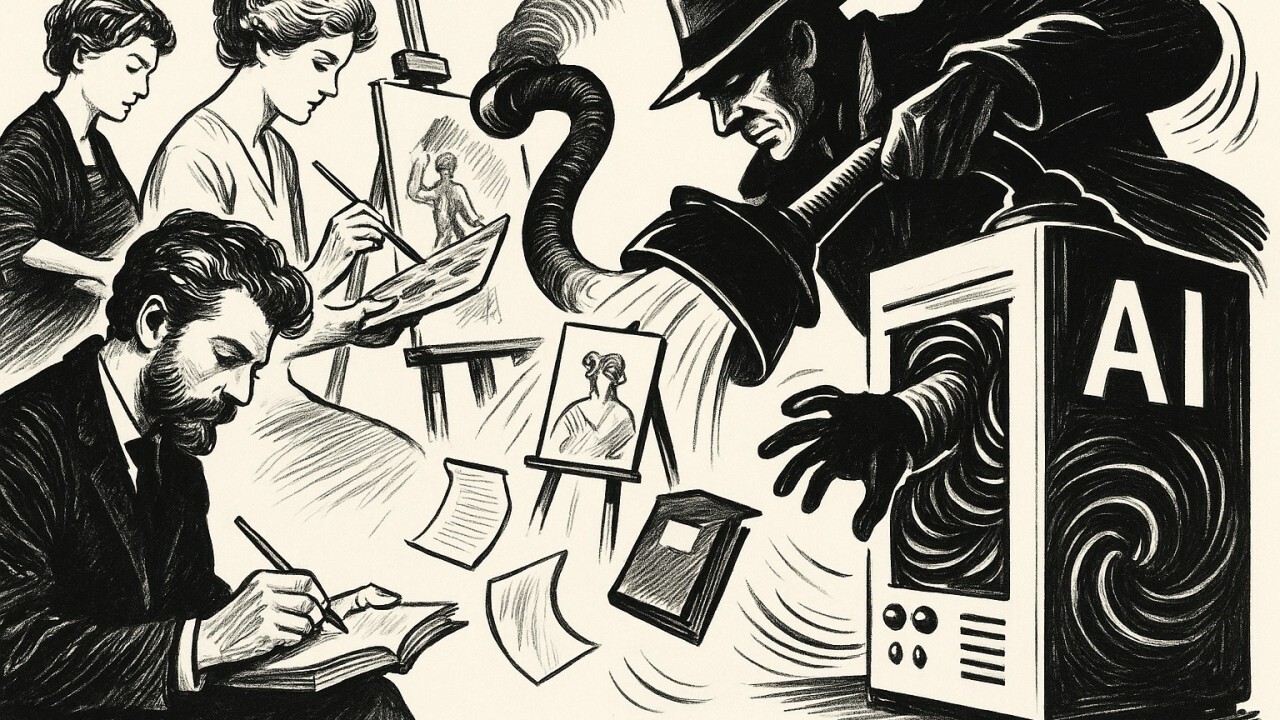
Your proprietary processes. Your customer lists. Your pricing models. Your product designs. Your strategic plans.
Where is all of that information right now?
If your employees are using ChatGPT, Claude, Copilot, or any of the dozens of AI tools flooding the market, the answer may be: sitting on servers owned by companies that have no obligation to protect your interests.
The New Data Leak Isn't a Hack. It's a Productivity Tool.
We spend enormous energy worrying about external threats. Firewalls. Intrusion detection. Ransomware. And we should. But while IT security teams watch the perimeter, company data is walking out the front door, one helpful AI prompt at a time.
Consider what happens when an employee pastes confidential information into a free AI tool:
- A salesperson uploads a customer list to "help format a proposal."
- An engineer pastes proprietary specifications to "debug a problem."
- A finance manager inputs pricing data to "build a model."
- An HR director shares compensation details to "draft a policy."
Each of these actions, done with good intentions and no malice, potentially transfers your intellectual property to a third party. And here is where it gets uncomfortable: most AI providers' terms of service grant them rights to retain your inputs, use them to improve their services, and in some cases, train future models on them.
Opt-outs exist. But they are buried in settings menus that most employees will never find, and they often apply only to paid enterprise tiers. The free tools your team downloaded without asking IT? Those likely have far fewer protections.
The Actual Risk (Not the Exaggerated One)
Let me be precise about what the threat is and is not.
The risk is not that your competitor will type a question into ChatGPT and receive your proprietary formula verbatim. That is not how these systems work. Large language models do not store and retrieve specific inputs on demand.
The risks that are real:
- Retention. Your data may be stored on servers you do not control, subject to breaches, subpoenas, or policy changes you will never be notified about.
- Human review. Some providers reserve the right to have employees review inputs for safety, abuse detection, or quality assurance. Your confidential data could be seen by people you have never met.
- Aggregate learning. While your specific input may not be retrievable, patterns from millions of inputs (including yours) can inform how the model responds to similar queries from anyone, including competitors in your industry.
- Terms that change. What is protected today may not be protected tomorrow. Providers update their terms regularly, and continued use is often deemed acceptance.
None of this requires malice. It is simply the business model.
The Uncomfortable Economics
Paid enterprise AI tools often come with stronger data protections, contractual commitments, and explicit exclusions from training. But those cost money, require IT involvement, and take time to implement.
So employees reach for the free version instead.
And free tools are not free. You pay with data. The providers benefit from what you give them. You absorb the risk. This is the bargain most companies have made without realizing they made it.
The parallel to what is happening with creative intellectual property is instructive. Courts have recently ruled that AI companies can use copyrighted books to train their models under "fair use" doctrine, deeming the practice "exceedingly transformative." At the same time, Anthropic just agreed to pay .5 billion to settle claims over pirated training data. The legal landscape is contradictory, evolving, and offers little comfort to those whose work has already been consumed.
Your business data is not protected by copyright in the same way. But the underlying dynamic is similar: once it enters these systems, you have limited visibility into how it is retained, used, or learned from. And clawing it back is not an option.
Every company without an AI usage policy is, in effect, granting permission for this to happen, whether they realize it or not.
What Most Companies Are Missing
Here is what I see when I talk to manufacturing executives about AI:
- No policy exists. Employees are using AI tools with zero guidance on what can and cannot be shared.
- No training has occurred. Most employees do not understand that AI tools may retain data, much less what the implications are.
- No visibility is in place. Leadership has no idea which tools are being used, by whom, or with what data.
- No accountability is defined. When (not if) a data exposure occurs, who is responsible? Nobody knows.
This is not a technology problem. It is a governance problem. And governance is a leadership responsibility.
The Practical Reality
I am not here to tell you AI is dangerous and should be avoided. That would be foolish. AI is a powerful tool, and companies that use it well will outperform those that do not.
But "using it well" requires intentionality. It requires policy. It requires training. It requires someone in the room who understands both the technology and the business risk, and can translate between the two.
Most companies in the M to M range do not have that person. They have an IT manager or a small team keeping the lights on. They do not have someone thinking strategically about data governance, AI exposure, and long-term risk.
That gap is where the exposure lives.
The Question You Should Be Asking
If you are a CEO or COO reading this, here is the question that should concern you:
What confidential information has already been shared with AI tools, and do I have any way of knowing?
If the answer is "I don't know," you have a problem. Not a theoretical future problem. A current, present-tense problem that may or may not be reversible.
The time to address it is now. Not after an incident. Not after a competitor shows up with something suspiciously similar to your process. Now.
Do Something About It
At minimum, every company should have:
- A clear AI usage policy defining what types of information can and cannot be entered into AI tools, and which tools are approved for use.
- Employee training ensuring everyone understands the risks, not just the IT department.
- Approved tool lists distinguishing between consumer-grade free tools and enterprise tools with appropriate data protections.
- Monitoring and accountability so violations are detected, not discovered after the fact.
This is not difficult. It does not require a massive budget. It requires leadership attention and someone with the expertise to implement it properly.
If you do not have that expertise in-house, find it. The cost of getting this right is trivial compared to the cost of getting it wrong.
Raphael Savastano is the founder and principal consultant of ROFONIC LLC. With 25+ years in IT, 16 years in leadership, including 8 years as CIO scaling technology for a global manufacturer from M to 0M. He now helps growing companies get executive-level technology and operations leadership without the full-time cost. Want to know where your technology actually stands? Take the Founder's IT Reality Check →